Live music happens once. Even the best recording can’t hold the whole of it: hearing your own breath and heartbeat become part of the sound, the way a drum lands in your chest, the quiet of a room full of people listening together. The sound can be saved, but the experience can’t.
I’ve been thinking about this because I work in clay, and my work is finished the moment it arrives in someone’s home. After that, I’m not there. Yet I’ve had experiences in the making that feel oddly like performance. Throwing, shaping, and curling porcelain while it’s soft are moments that never repeat, and a fingerprint or a fold in the finished piece is often the only trace they leave.
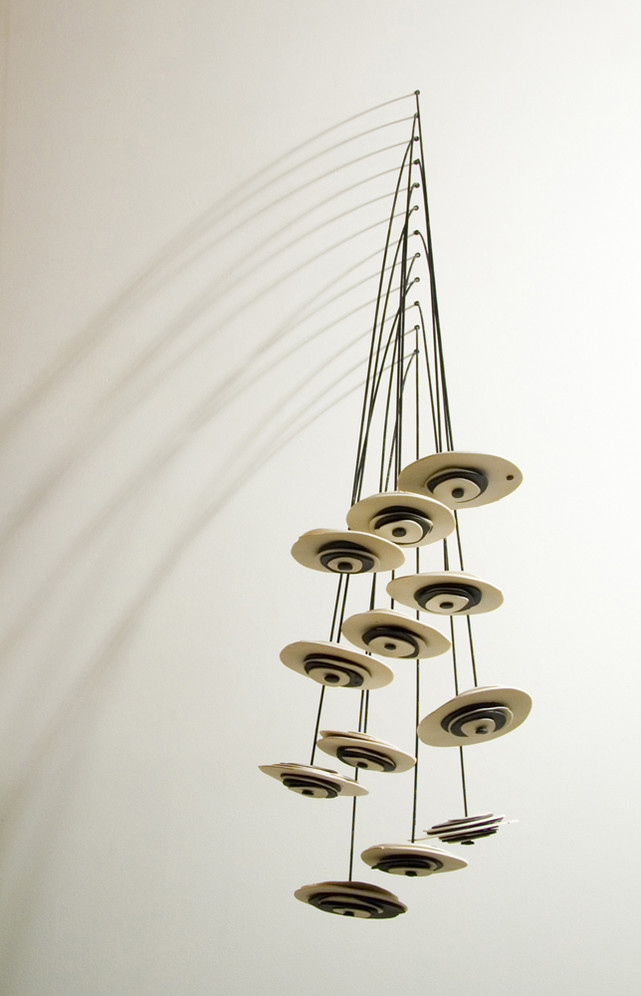
Some of my work continues that experience for the people who live with it. In my multi-part sculptures and my interactive wall pieces, light does the performing. As the day passes, the shadows cast by the ceramic components slowly travel and change. The piece is never quite the same at ten in the morning as at four in the afternoon, or in January as in July. I make the forms, and the sun plays them.
Other pieces invite hands. Stacked porcelain curls and ribbons can be rearranged, so the owner becomes a co-performer. Each arrangement is a small event that lasts until someone changes it. It’s less like looking at an object and more like improvising with an instrument left out in a room.
I find this surprising for ceramics, a medium we associate with permanence. Fired clay can outlast civilizations, and yet I’m drawn to the fleeting: a shadow crossing a curl of porcelain, an arrangement that exists only until the next one. A musical score is durable too, while each performance vanishes as it’s played. The material stays fixed and the experience doesn’t.
So my work is complete when it reaches its home, but the experience begins there, and it belongs to whoever is paying attention.